






Chad’s Blog
Pragmatic Technologies for Life and Business Success®

There is a pattern I keep seeing, and it is too consistent to ignore. A senior professional reads an article about AI transforming their industry. They nod. They agree. They may even forward it to a colleague with a note that says, “we should talk about this.” And then they go back to working exactly the way they worked last month. And the month before that. And the month before that.
This is not a discipline problem. It is not a motivation problem. It is not even a technology problem. The reason most experienced professionals have not meaningfully changed how they work with AI has nothing to do with AI at all. It has to do with something far more personal, far more deeply rooted, and far more difficult to see from the inside.
It has to do with who you believe you are as a professional. Let me explain.
The Gap Nobody Is Naming
James Clear, author of Atomic Habits and one of the leading voices on behavioral change, identified something that applies far beyond habits: the biggest barrier to positive change is not ignorance or even resistance. It is identity conflict. When a new behavior contradicts how you see yourself, you will find a way to avoid it regardless of how rational the case for change is.
Think about what that means for a consultant, an advisor, or a leader who has built a successful practice over 20 or 30 years. Your professional self-image is not some abstract concept. It is the picture you carry of yourself as the person who has the answers. The one who walks into a room and commands credibility because of what you know, what you have seen, and what you have navigated. That self-image has been reinforced by decades of client results, peer respect, and real-world outcomes. It is not fragile. It is foundational. It is how you understand your own value.
Now AI shows up and the market tells you to change how you think, how you work, and how you deliver value. The information is sound. The logic is clear. But something quietly resists, and it is not stubbornness. It is your professional self-image protecting itself. Because truly integrating AI as a thinking partner does not feel like adding a tool. It feels like admitting that the way you have been operating, the way that built everything you have, is no longer sufficient. And that is not an intellectual conclusion. It is an identity threat.
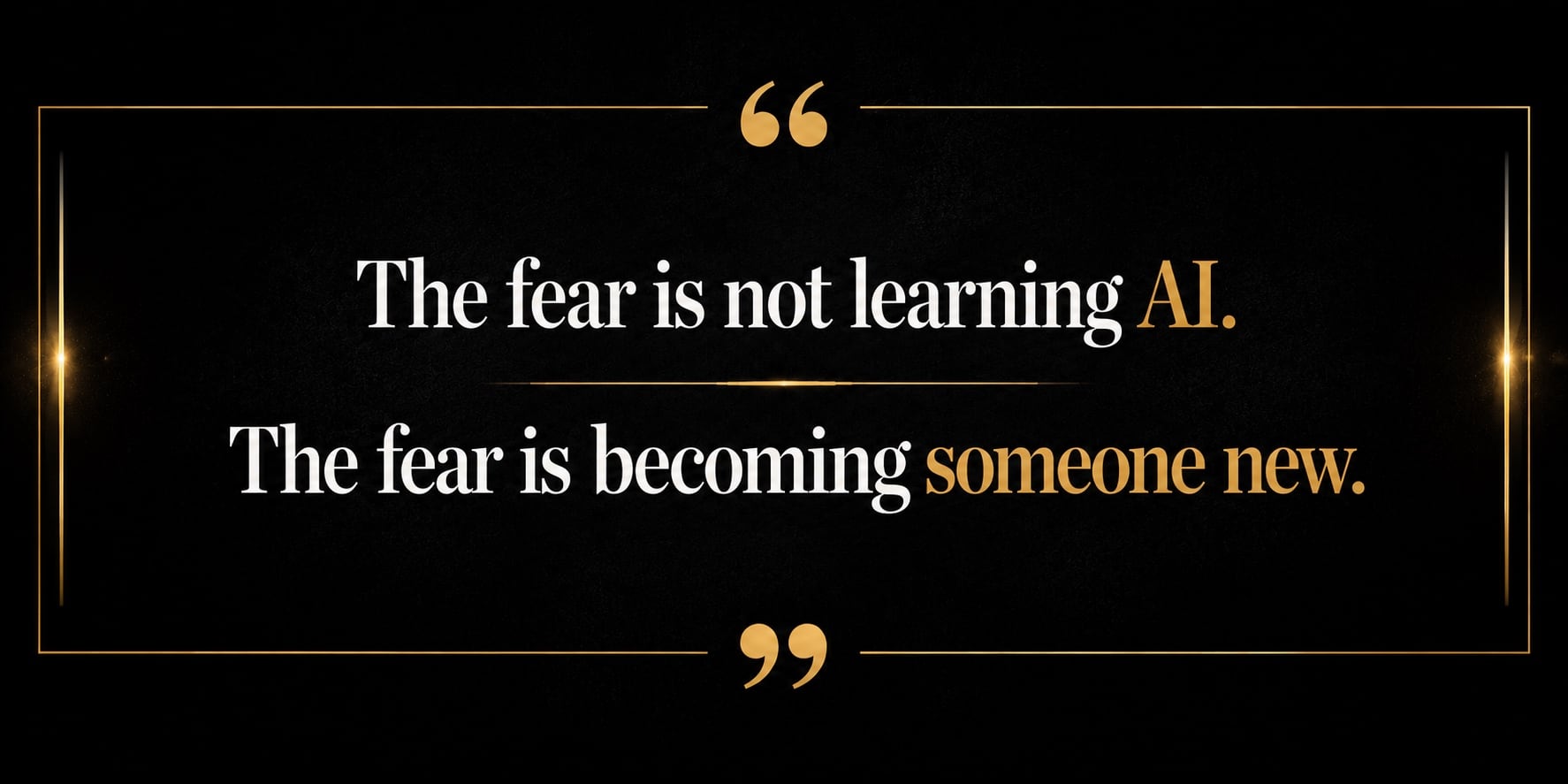
This is the gap nobody in the AI conversation is naming. It is not a knowledge gap. It is not a skills gap. It is the gap between what you know you should be doing and what your professional self-image will allow you to do. Until that gap is addressed, no amount of tutorials, webinars, certifications, or articles will produce lasting change. The fear is not learning AI. The fear is becoming someone new.
Why the Market’s Solution Cannot Fix This
Here is where the entire AI education industry is getting it wrong. The assumption is straightforward: if professionals just learn enough about AI, they will adopt it. So, the market floods them with courses, masterclasses, prompts, tool comparisons, and certification programs. All of it is information delivery.
Look at what passes for AI education in most corners of the market. Self-appointed AI experts post a barrage of prompts for their followers to execute. How to generate a fancy infographic. How to write a LinkedIn post in thirty seconds. How to automate a task you probably should not be automating. What none of it addresses is how to use AI to elevate your thinking. How to make it a genuine thinking partner that sharpens your judgment, challenges your assumptions, and ultimately elevates who you are personally and professionally. The entire conversation is stuck at the production layer, teaching people to make things faster, when the real leverage is at the thinking layer, learning to think things through better.
And information delivery, no matter how slickly packaged, does not change self-image. It never has.
Consider an analogy from a completely different domain. A senior executive is told by a physician that their health requires a fundamental change in how they eat and exercise. The executive understands the data. They can recite the risks. They may even buy a book about nutrition and read it cover to cover. But six months later, nothing has changed. Not because they did not understand. Because their identity as “someone who powers through” or “someone who does not have time for that” was never addressed. The information was absorbed. The self-image was untouched.
The same dynamic is playing out with AI across every professional services firm, every independent consultancy, every advisory practice. Professionals are consuming AI content at an unprecedented rate. They are attending conferences, reading newsletters, watching demos. And most of them are operating almost identically to how they operated two years ago. The problem is not the content. The problem is that content consumption does not produce identity shift.
This is why the smartest professionals in your network, the ones who understand AI’s implications better than anyone, are often the most stuck. They have the clearest intellectual picture of what is coming and the deepest professional self-image invested in how things have always worked. Intelligence is not the bottleneck. Self-image is.
What Actually Moves the Needle
If information alone does not shift professional self-image, what does? This question has driven the first four sessions of the AI Insider Lab, and what I have observed in those sessions has sharpened my thinking considerably.
Self-image does not change through consumption. It changes through experience, specifically three conditions that have to be present simultaneously.
The first is sustained practice on real work. Not practice exercises, not hypothetical scenarios, not “try this prompt and see what happens.” The shift begins when you use AI to pressure test a real recommendation you are about to make to a real client, and the AI surfaces a blind spot you genuinely had not considered. That moment, when AI makes your actual work better in a way you can feel, is when the self-image begins to update. But one experiment is not enough. You have to show up and do the work, repeatedly. You have to treat every engagement as an experiment, bring a real problem, push AI to challenge your thinking, evaluate what comes back, and refine. It is the accumulation of those experiments that rewires your professional self-image, not a single impressive interaction. There are no shortcuts here. The professionals who make this shift are the ones willing to do the work consistently, not the ones who read about it and wait for the right moment.
The second is peer reinforcement, and that includes following a leader you trust. Identity does not shift in isolation. It shifts when you see people you respect making the same transition. When a peer you consider sharp and experienced shares how they used AI to challenge their own strategy and arrived at a better answer, something recalibrates. It becomes possible to integrate AI into your professional self-image because someone who looks like you professionally has already done it. But peers alone are not enough. You also need a leader who has walked the path ahead of you, someone who has tested this on their own business, demonstrated the results publicly, and is not theorizing about the shift but living it. When you can see the leader doing the work and the peers alongside you doing the work, the old self-image loses its grip. This is not about motivation or inspiration. It is about expanding what your professional self-image considers possible.
The third is environment. The professional landscape you operate in either reinforces the old self-image or supports the new one. An environment where AI use is expected, where experimentation is normal, where the conversation is about how to think with AI rather than whether to use it, creates the conditions for the shift to take hold. Without that environment, even professionals who have the practice and the peer exposure tend to revert to old patterns because nothing in their daily context reinforces the new identity.
These three conditions explain why courses fail and communities succeed. A course delivers information in a bounded timeframe with no sustained practice, no peer reinforcement, and no ongoing environment. A working community provides all three simultaneously. That is the difference between knowing about a change and actually making it.
Inside the AI Insider Lab, I watch this happen in real time. Members who arrived uncertain about whether AI had a meaningful place in their practice are now bringing real client challenges to sessions, using AI as an adversarial thinking partner, and doing work that is measurably sharper because of it. They did not get there by consuming more content. They got there because the professional landscape, the peer group, and the sustained application gave their professional self-image room to evolve.
One member, a lifelong writer with university degrees in the subject who has taught writing at the college level, put it this way after completing his AI Playbook, an experiment I assign to our members: “I’ve been writing all my life. The process of going through the exercises you’ve prescribed has taught me a little about why I haven’t published enough.” That is not a technology breakthrough. That is a self-image breakthrough. He is now using AI to execute a real client project, applying what he built in the Lab to work that matters. That is how identity change works. It does not announce itself. It accumulates through doing the work.
This is what the AI Insider Lab was designed to produce. Not AI literacy. Not tool training. An actual shift in how serious professionals see themselves and operate. It is a thinking environment where the practice is real, the peers are experienced, and the work compounds session over session. The members already inside are not learning about AI. They are becoming professionals who think with AI as a natural extension of their expertise.
If you have read every article, attended every webinar, and still have not fundamentally changed how you work, the problem is not your effort. The problem is that nothing in your current environment is designed to support the shift.
The AI Insider Lab is.

Get your copy of my latest new books available now on my Amazon’s author page.