





Chad’s Blog
Pragmatic Technologies for Life and Business Success®
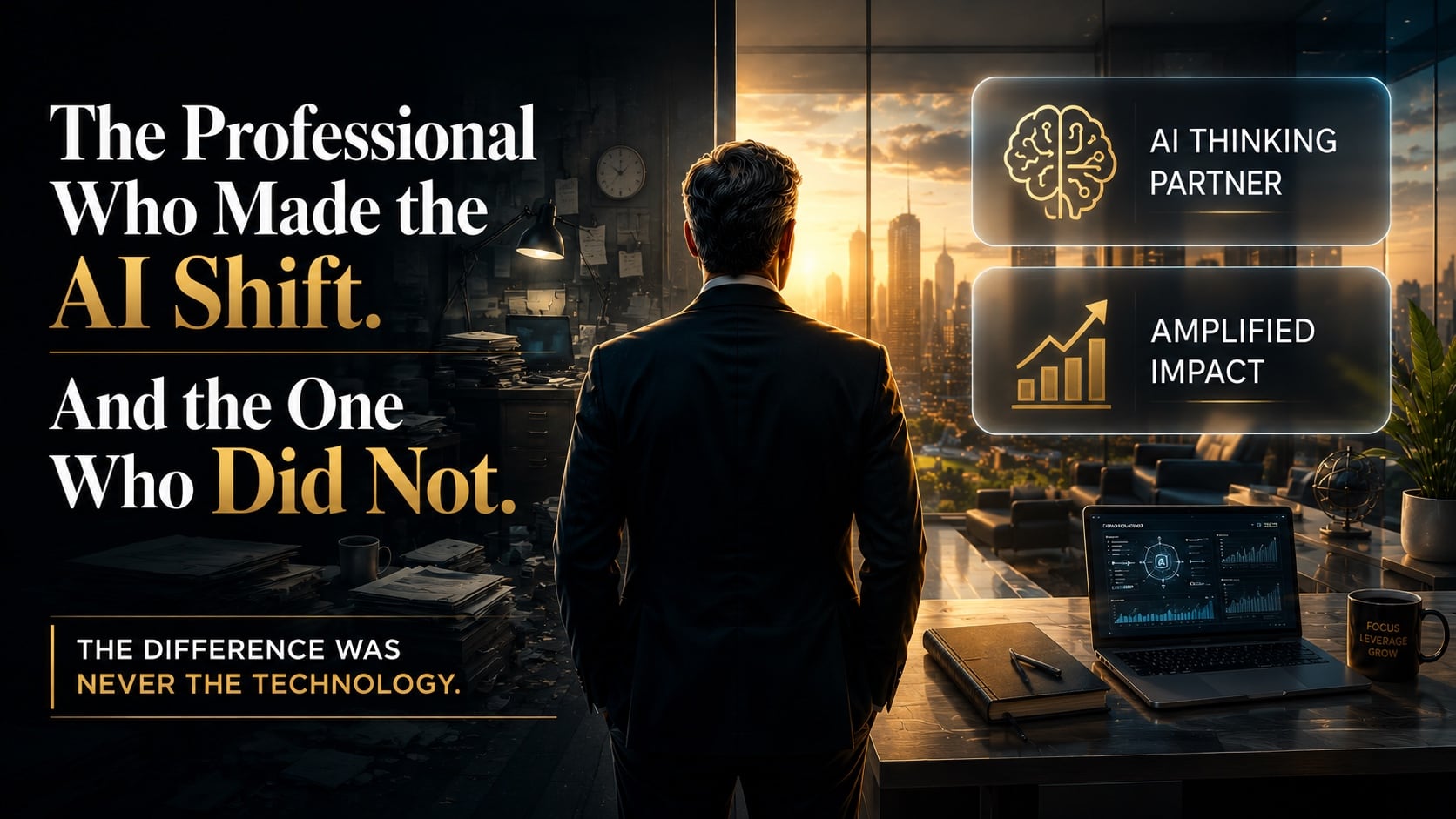
Two years ago, these two professionals were indistinguishable. Same caliber of expertise. Same decades of client work. Same reputation in their respective markets. Both heard the same message about AI changing everything. Both believed it intellectually. Both had access to the same tools.
Today, one of them operates with a confidence and clarity that clients notice immediately. The other is working harder than ever and falling behind in ways that are difficult to name but impossible to ignore. The difference between them has nothing to do with talent, intelligence, or even technology. It has everything to do with a shift that one of them made and the other is still avoiding.
The One Who Did Not
You know this professional. You may be this professional. They stayed current. They read the articles, attended the webinars, downloaded the tools. They experimented with ChatGPT a few times, maybe generated a proposal draft or asked it to summarize a report. They can hold an informed conversation about AI at a dinner party. None of that changed how they actually operate.
Their week looks the same as it did in 2023. They prepare for client engagements the way they always have, pulling from experience and intuition, trusting the process that has worked for decades. Their proposals follow the same structure. Their research takes the same amount of time. Their content, when they produce it at all, sounds competent but interchangeable with a hundred other advisors in their space. They know this. It sits somewhere in the background, a low-grade unease they can push aside most days but cannot quite silence.
The evidence is already showing up, even if they are not ready to see it.
Never the real reason, which is that the value this professional delivers no longer stands out in a market where competent analysis is available to anyone with a subscription.
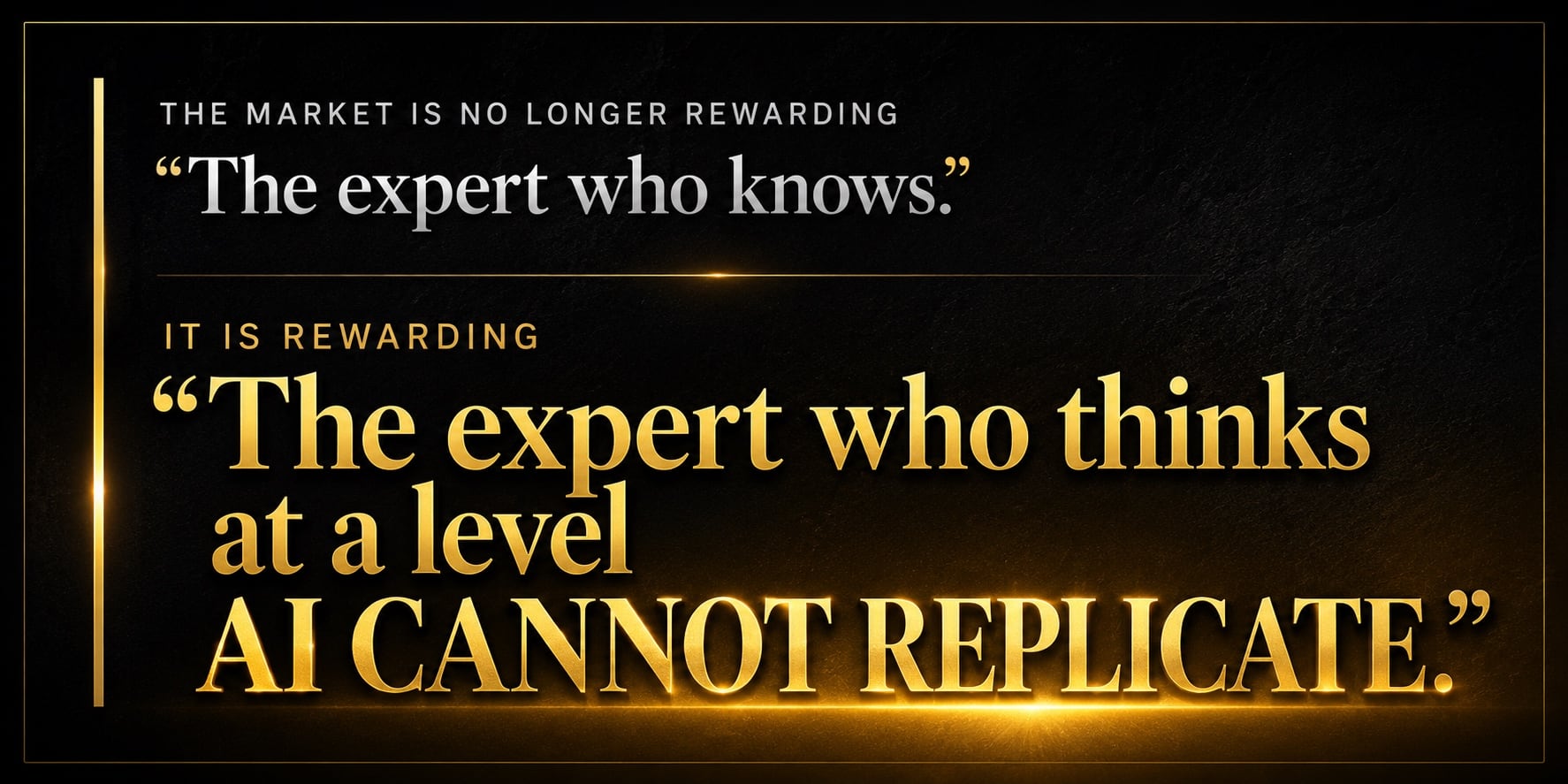
The hardest part is that this professional is not doing anything wrong by any historical standard. They are doing exactly what made them successful for the last 20 years. The problem is not their performance. The problem is that the standard has moved and their professional self-image has not moved with it. They are still operating as “the expert who knows,” when the market is now rewarding “the expert who thinks at a level AI cannot replicate.” Those are not the same professional, and the distance between them is growing consistently into a gap that is already impossible to close.
The One Who Made the Shift
This professional started from the same place. Same uncertainty, same skepticism, same protective instinct around an identity built over decades of hard-earned credibility. The difference is not that they were braver or more tech savvy. The difference is that they put themselves in an environment where the shift could happen, and then they did the work.
It started with a single experiment. Not a tutorial, not a prompt copied from LinkedIn, but a real business problem brought to AI as a thinking partner. They took a client recommendation they were about to deliver and asked AI to challenge it. To find the weaknesses. To argue the other side. The first time, it was uncomfortable. The AI surfaced a blind spot they genuinely had not considered, and the instinct was to dismiss it. They did not. They sat with it, revised their recommendation, and delivered something stronger than what they would have produced alone. That was the first crack in the old self-image.
What followed was not a sudden transformation. It was one experiment after another, each one building on the last. They ran the experiment again on the next client engagement. Then the next. They started using AI to pressure test their positioning, to stress test their proposals, to interrogate their own assumptions before walking into a room. Each time, the work got sharper. Each time, the professional self-image quietly updated: from “I am the person who has the answers” to “I am the person whose thinking has been tested more rigorously than anyone else in the room.”
Inside the AI Insider Lab, I have watched this progression across multiple members over five sessions. One member now uses AI to research client industries, process meeting recordings into structured summaries, and prepare for engagements with a depth that was not possible at his previous pace. Another leveraged his experience with multiple AI platforms to build cross platform workflows that convert his intellectual property into scalable content. In our most recent session, both stood up and demonstrated to the group how they are applying AI in their businesses right now. Not theoretically. Not as a future goal. In real time, on real work, producing real results. That kind of peer demonstration does something no tutorial can: it rewires what the room considers normal.
Another member completed his Strategic AI Playbook and described the result as exceptional. But the deeper insight was not about the output. He said the process of going through the exercises taught him something about why he had not published enough despite decades of writing expertise. That is not a technology discovery. That is a professional self-image discovery, surfaced through doing the work inside an environment designed to produce exactly that kind of breakthrough.
And then there is what I showed the group at the end of that session. Two fully functional portals, ProPromptGenius and the AI Insider Lab member portal, both built through Lovable in a matter of weeks. Not months. Not with a development team of ten. Built with AI as a genuine development partner, producing functionality that prior to this moment would have required months of traditional software development and significant budgets. I did not tell the group that AI accelerates what is possible. I showed them. That is Permission Through Demonstration, one of my profound frameworks AI has helped me recognize, and it is the only proof structure that moves a professional from “I understand this intellectually” to “I am doing this now and it is changing how I operate, how I think, how I execute, and how I deliver.”
The Difference Was Never the Technology
Both professionals had access to the same AI tools from day one. The same models, the same capabilities, the same tutorials and prompt libraries and YouTube demonstrations. The technology was never the differentiator.
The professional who made the shift did three things the other did not.
The professional who did not make the shift consumed more information about AI than most people will encounter in a lifetime. They understood the case for change better than 90 percent of their peers. And they changed nothing fundamental about how they operate, because nothing in their environment, their peer group, or their daily practice gave their professional self-image permission to evolve. They were surrounded by people who talked about AI the same way they did: with interest, with curiosity, and with no intention of actually becoming someone different because of it.
That is the dividing line. Not knowledge. Not capability. Not access. The line is between professionals who entered an environment designed to produce the identity shift and those who kept waiting for the shift to happen on its own. It does not happen on its own. It never has.
The professional who made the shift did not wait until they felt ready. They started before they were comfortable, inside an environment that made starting possible. The one who did not is still preparing. Still consuming. Still waiting for a moment that feels right.
That moment does not arrive. You either step into the shift or you watch it happen to the people around you. Which professional are you today, and more importantly, which one will you be six months from now?

Get your copy of my latest new books available now on my Amazon’s author page.