






Chad’s Blog
Pragmatic Technologies for Life and Business Success®
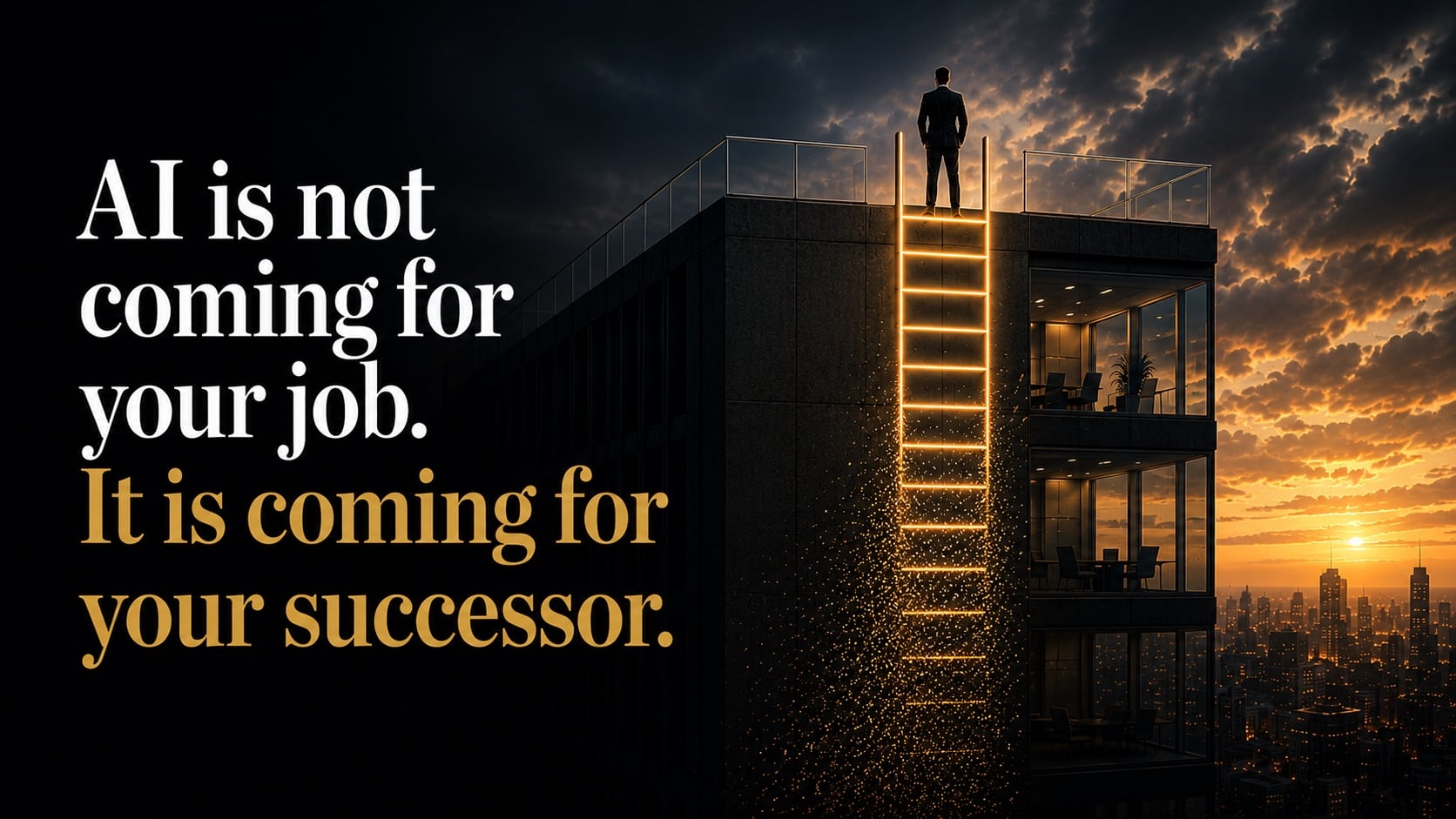
Everyone is asking the wrong question about AI and jobs. The fear is that AI will replace senior professionals. It will not. Not yet, and probably not in the way most people imagine. The real disruption is quieter, more structural, and far more dangerous: AI is eliminating the entry level and junior roles that train the next generation of senior professionals. The pipeline that creates your future replacement, your future partner, your future successor, is breaking. And almost nobody is paying attention because the cuts are invisible.
The Invisible Cut
The jobs disappearing are not the ones making headlines. They are the ones that quietly never get posted. Research associates, junior analysts, first draft writers, data gatherers, project coordinators. These roles are not being laid off. They are being absorbed, folded into AI workflows, removed from hiring plans, and eliminated through attrition rather than announcement. Entry level hiring across knowledge work professions has already dropped by as much as 35 percent. I explored this trend in Your Expertise Has a Shelf Life. Here Is What Replaces It as part of a broader argument about expertise depreciation. But the full weight of that trend deserved more than a single paragraph. The implications deserve their own examination, because what looks like an efficiency gain on a quarterly report is actually a structural fracture in how professions develop talent.
No one is sounding the alarm because there is nothing dramatic to point to. No mass layoffs. No protests. Just a slow, steady disappearance of the bottom of the professional ladder.
This is no longer a fringe concern. The conversation has reached the boardroom, the business schools, and the industry journals. But nearly all of that discussion is aimed at the organizations making the decision. Almost none of it is aimed at the advisors those organizations depend on for strategic guidance. That is the gap this article addresses.
The Broken Ladder
Here is what most organizations are not seeing. Those junior roles were never just labor. They were apprenticeships. They were how professionals learned to think, developed judgment, made mistakes in low stakes environments, and built the pattern recognition that eventually made them senior. The repetitive work that AI now handles, the research, the drafting, the data compilation, was not wasted time. It was training disguised as production.
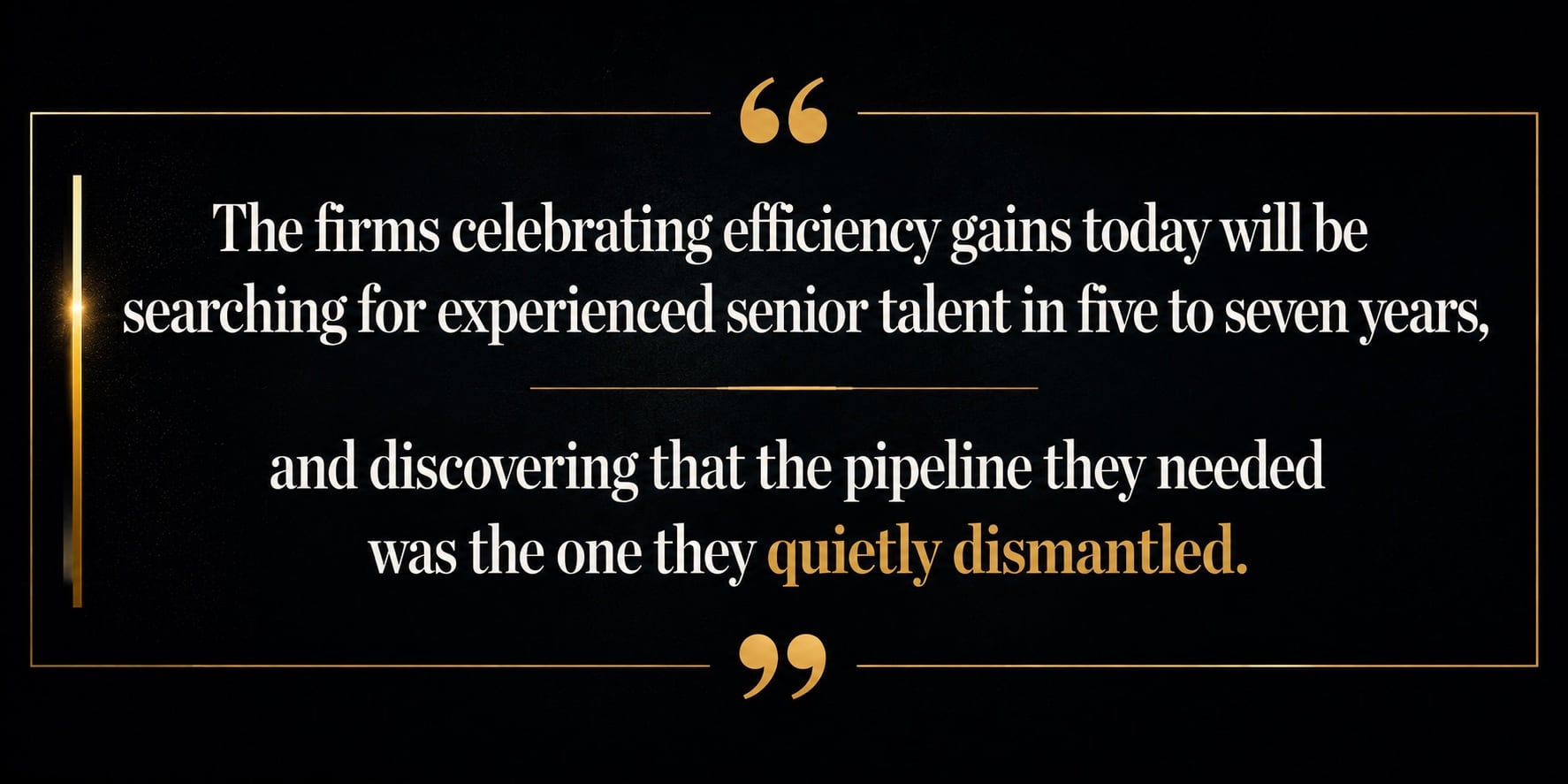
When you remove the bottom rungs of the ladder, nobody climbs it. The firms celebrating efficiency gains today will be searching for experienced senior talent in five to seven years and discovering that the pipeline they needed was the one they quietly dismantled. This is not a hiring problem. It is a structural collapse of the professional development model that has operated for decades, and the organizations making this decision are doing it without realizing they are making it at all.
The Client Blind Spot
This is where the article becomes personal for you. Your clients are making this decision right now. They are asking whether they can replace their junior analysts, associates, and coordinators with AI. Many of them already have. And the short-term results look excellent: lower costs, faster output, fewer management headaches.
The question nobody is asking them is what happens in five years when they need senior people and there is no one in the pipeline. The firms that eliminated junior roles to save money will be competing to hire experienced professionals from a shrinking pool, paying premium salaries for talent they could have developed internally at a fraction of the cost. This is not speculation. It is the predictable second order consequence of a decision being made across industries right now.
If you are a consultant, coach, or advisor, this is an immediate opportunity. The conversation your clients need is not “how do you use AI to replace junior work?” It is “how do you redesign your organization so AI makes your people stronger rather than making them unnecessary?” That is a higher order strategic conversation, and it is exactly the kind of work that justifies premium advisory fees.
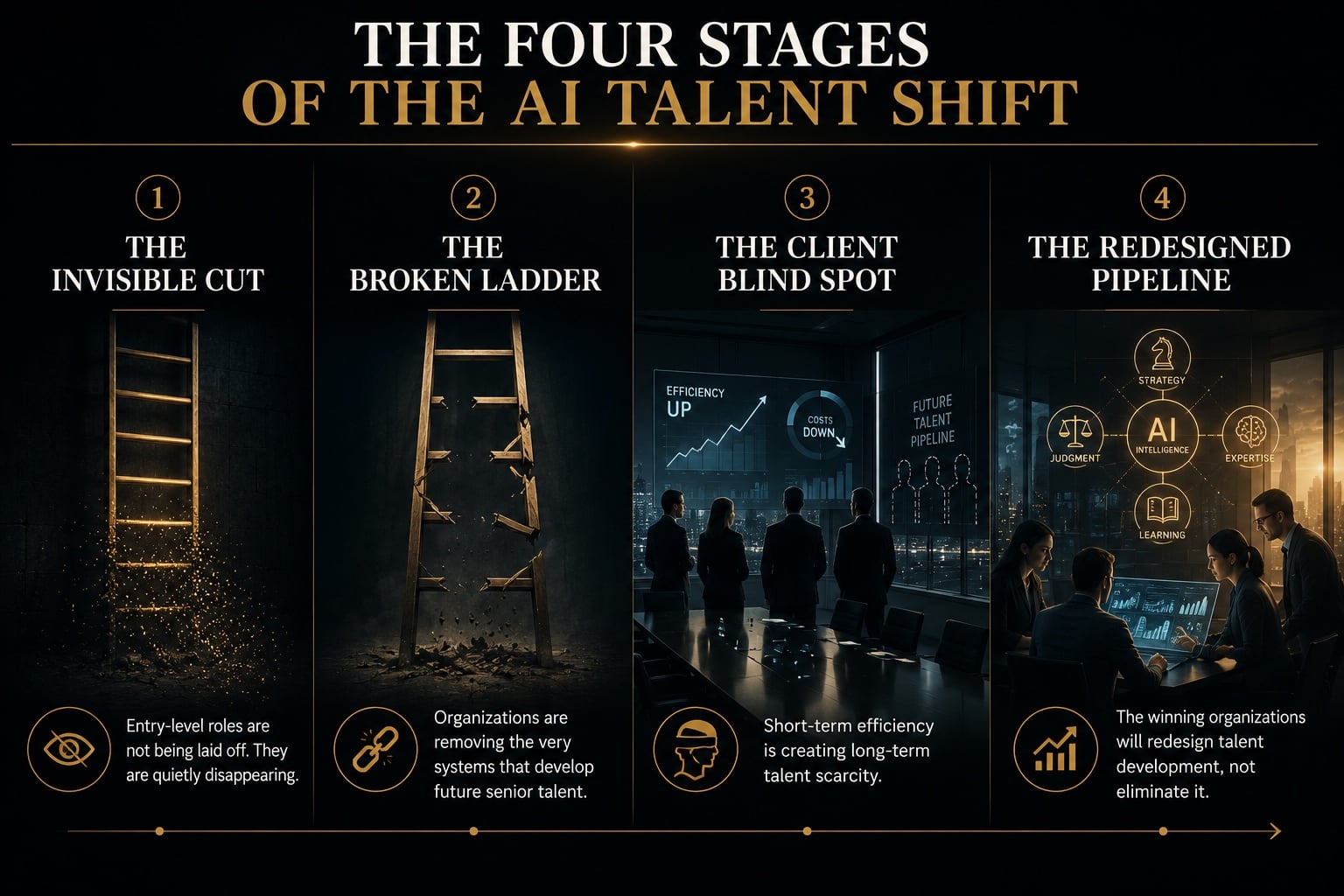
The Redesigned Pipeline
The answer is not to resist workforce reduction. AI will reduce headcount in most organizations. That is already happening. The question is whether it happens by default or by design.
When the only goal is cost reduction, the result is erosion: fewer people, same structure, growing gaps in institutional knowledge and talent development. When the goal is strategic redesign, the result looks fundamentally different. Consider that at one of the leading AI companies, AI now writes the vast majority of the code, yet the engineering team has not been cut. The work shifted. Engineers moved from writing code to deciding what to build, reviewing AI output, and making the judgment calls that determine whether the product actually works. The headcount did not change. The value of each person went up. It means compressing the professional development timeline so that a junior professional who used to spend three years on mechanical tasks now spends 18 months doing higher cognitive work alongside AI, developing judgment and strategic thinking at twice the speed. It means building AI augmented teams where fewer people operate at a higher level, participating in interpretation and strategy rather than just producing raw inputs. It means capturing the institutional knowledge of senior professionals in structured systems so that organizational intelligence survives even as the workforce contracts. The organizations that treat AI as a cost cutting tool will get exactly what they paid for: a leaner operation with a gutted foundation. The organizations that treat it as a redesign opportunity will build something their competitors cannot easily replicate: a smaller, sharper workforce where every person operates at a level that used to require years more experience.
This is the kind of structural thinking we work on inside the AI Insider Lab. Not just how to use AI personally, but how to advise clients through the most significant organizational redesign most industries have faced in decades. It is a working environment where serious professionals are building the strategic frameworks their clients will need, in real time, on real problems. The members already inside are not just adapting to AI. They are learning how to lead others through the transition.

Get your copy of my latest new books available now on my Amazon’s author page.