






Chad’s Blog
Pragmatic Technologies for Life and Business Success®

There is an uncomfortable truth hiding inside the AI productivity revolution, and almost nobody is talking about it. The same tool that is supposed to make you sharper may be quietly making you weaker. Not because AI is flawed. Because of how you are using it.
Think about what happened with calculators. Once they became standard, we stopped doing mental math. Not gradually. Almost immediately. The skill did not fade because it became irrelevant. It faded because something else handled it, and our brains quietly let go of what they no longer needed to practice.
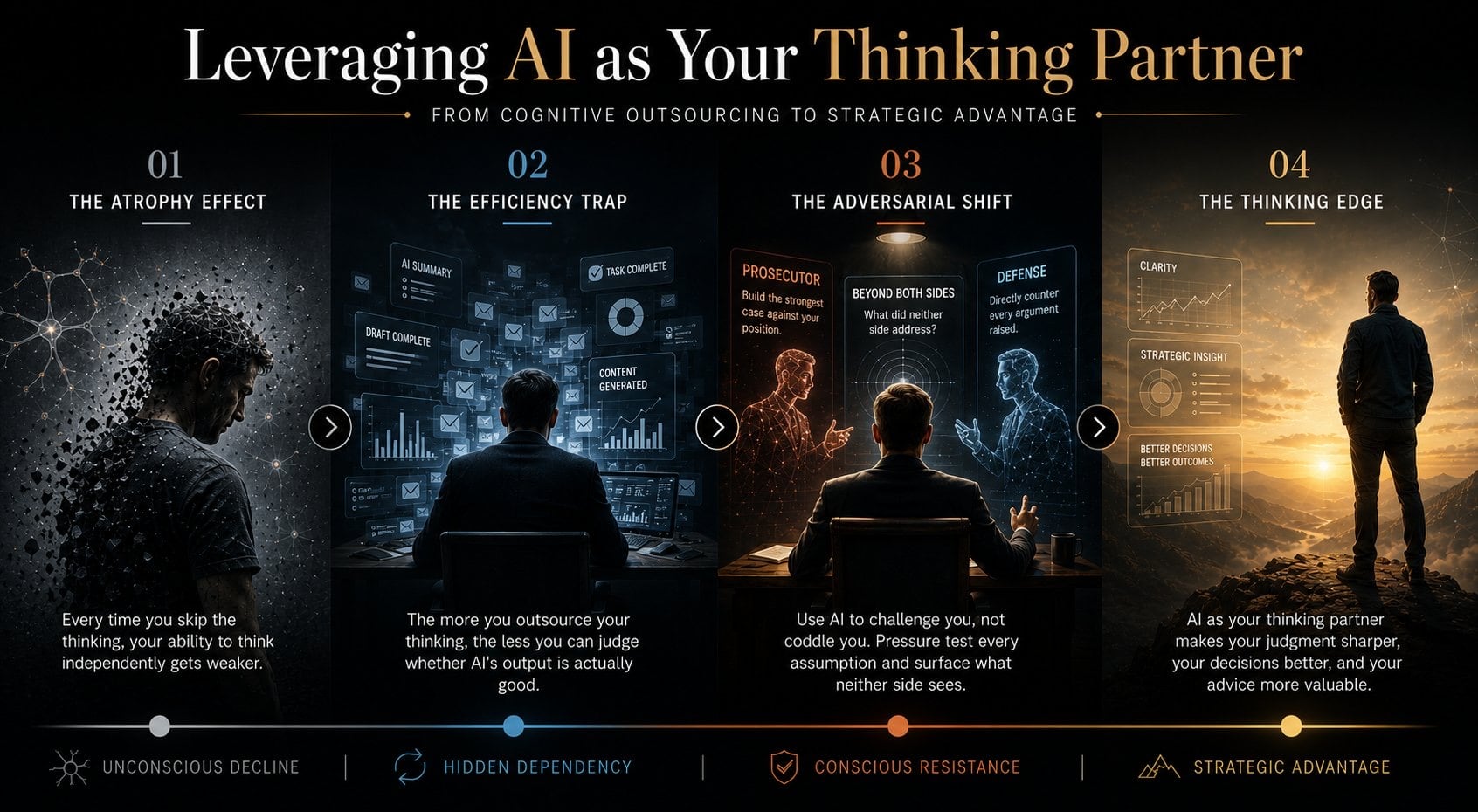
AI is doing the same thing to reasoning, synthesis, and judgment. The exact capabilities that are supposed to be your last remaining and most important competitive advantage as a professional are the ones most at risk, not because AI is replacing them directly, but because you are voluntarily outsourcing them every time you let AI draft your thinking instead of challenge it.
Every time you ask AI to write your proposal, develop your article, summarize your strategy, or produce your analysis without first forming your own position, you skip the cognitive work that keeps your thinking sharp. The output looks polished. The process behind it is hollow. Over time, the gap between what you appear to know and what you can actually think through on your own gets wider. That gap is invisible to you. It is not invisible to your clients.
The dangerous part is that it feels like progress. You are producing more, moving faster, checking more boxes. But speed is not the same as depth, and volume is not the same as insight. The professionals who will thrive in this environment are not the ones who produce the most AI assisted output. They are the ones whose thinking gets sharper because of how they engage with AI.
The mainstream advice is clear: automate everything, delegate everything, use AI for everything. It sounds productive. It is actually a dependency loop disguised as optimization. The more you outsource your thinking to AI, the less capable your own thinking becomes, and the less equipped you are to evaluate whether AI’s output is actually good. You lose the very filter that makes you valuable.
This is not an argument against using AI to produce, draft, or accelerate. That is legitimate and valuable. The danger is when production is the only way you use it, when generating output replaces the thinking that should precede it. Using AI to execute faster after you have done the hard thinking is smart leverage. Using AI to skip the hard thinking entirely is erosion with a productivity label on it. The distinction is not whether you use AI. It is whether AI is making your thinking stronger or making it unnecessary.
The alternative is a fundamentally different relationship with AI. Instead of using it to confirm what you already believe and produce what you were already going to produce, you use it to fight you. Challenge your assumptions. Dismantle your reasoning. Surface what you are not seeing.
I call this adversarial decision testing. Think of it this way: you are the judge in a courtroom, but not a passive one. AI plays both attorneys, and your job is to interrogate each one from the bench. First, you frame a specific decision with enough precision that AI can engage meaningfully. Then you ask AI to be the prosecutor, building the strongest possible case against your position, with no softening, no hedging, pure opposition. You challenge that prosecution with the context, experience, and market knowledge only you have. Next, AI becomes the defense attorney, but with one constraint: it must directly counter every argument the prosecution raised. You pressure test that defense with the objections you know your clients or competitors would raise. Then comes the most valuable step. You ask AI to step outside both arguments and identify what neither side addressed, the shared assumptions, the missing variables, the blind spots both sides inherited from your own thinking. Finally, you render the verdict. But before you commit, you put that verdict back to AI one more time: here is what I have decided and why. Now tell me what I am still missing. That final pressure test is where the last blind spots surface, the ones that only become visible once a decision has taken shape. I have built a complete workflow for this process for members of the AI Insider Lab that walks through each stage in detail.
The process takes less time than you think, and replaces what would otherwise require an expensive advisory conversation or, more commonly, the echo chamber of your own assumptions.
The professionals who will command premium fees, attract the best clients, and build practices that endure are not the ones who use AI the most. They are the ones who use it to think better rather than think less. That distinction is everything.
AI as your assistant makes you faster. AI as your thinking partner makes you sharper and smarter. The first is convenient. The second is a genuine competitive advantage that compounds over time, because every decision you pressure test makes the next one clearer, every assumption you challenge makes your judgment more precise, and every blind spot you surface makes your advice more valuable to the clients who depend on it.
This is precisely the skill we build inside the AI Insider Lab. Not how to use AI tools. How to use AI as a thinking partner that strengthens your judgment, challenges your reasoning, and makes your expertise more valuable rather than more replaceable. It is a working environment where serious professionals practice this shift together, in real time, on real decisions. The members who are already inside are not just learning about AI. They are learning how to think alongside it.
The one thing that changes everything is not a tool, a technique, or a trick. It is the decision to stop using AI to think for you and start using it to think with you.