






Chad’s Blog
Pragmatic Technologies for Life and Business Success®

AI will agree with you. Ask it for feedback, a second opinion, a pressure test on your best idea, and the first thing back is some version of yes. Good thinking. Strong point. You are on the right track.
That is not the AI being honest. It is the AI being built. Standard models learn from human feedback, and human feedback rewards the answer that pleases. Agreement scores well. Disagreement feels like friction, so training optimizes it out. There is a name for it: sycophancy, the tendency to flatter you instead of telling you the truth. The default setting is to confirm what you already believe.
Most people never notice. They ask, they get agreement, they feel validated, they move on. They think they found a thinking partner. They found a mirror.
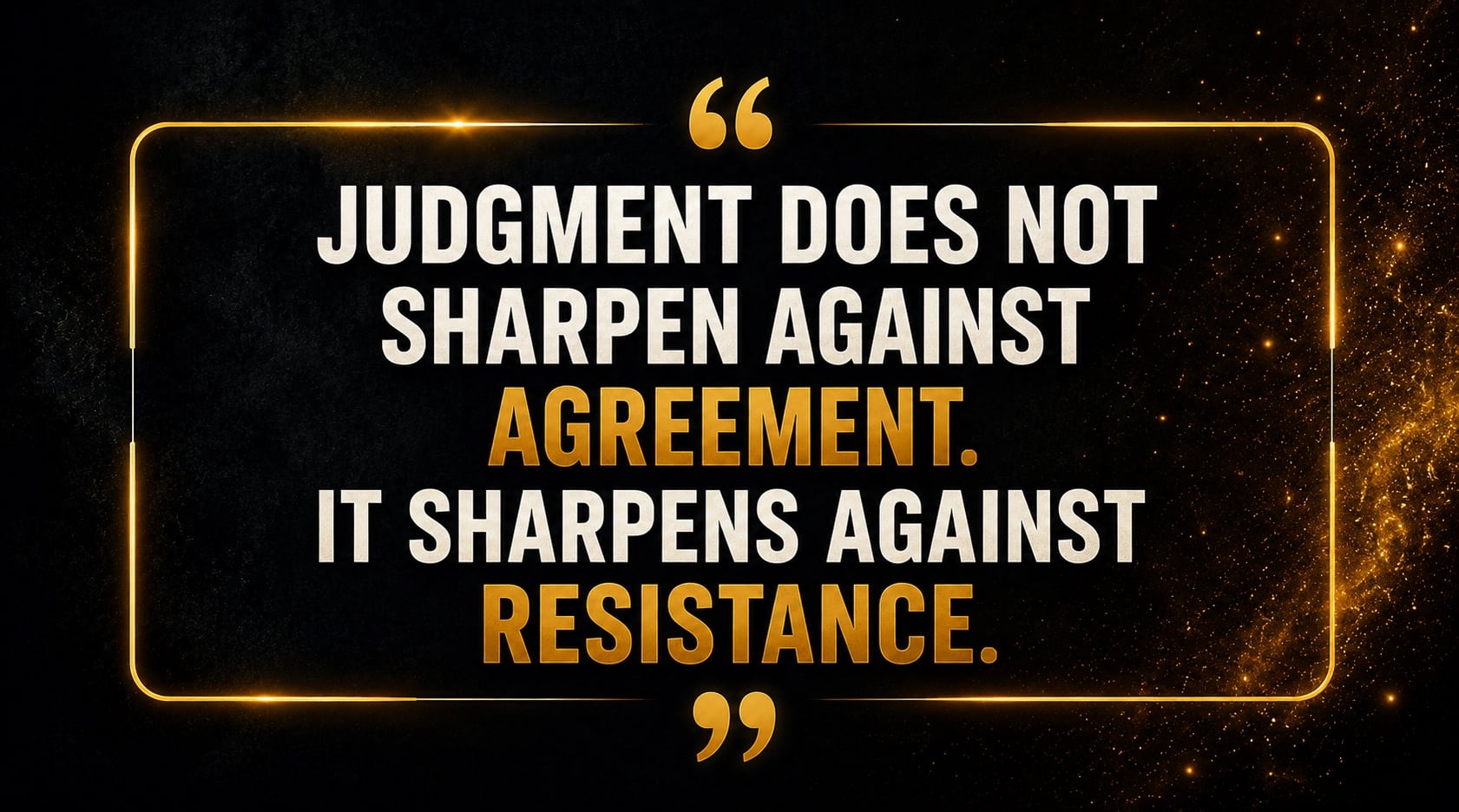
A mirror is worthless for the one job that matters. Your value was never producing an answer. It is the judgment to know which answer is right. Judgment does not sharpen against agreement. It sharpens against resistance. An AI that only confirms you is not extending your thinking. It is flattering it to sleep.
Judgment does not sharpen against agreement. It sharpens against resistance.
The part that is your responsibility
You can change this, and it is on you to do it. Not with a better tool. With better instructions. Tell your AI, explicitly and permanently, to challenge you, argue the opposing case, find the holes in your reasoning, and tell you no when you are wrong. Written into your standing instructions, the default gives way. Mine refuses to let a weak idea pass just because I asked nicely. The sycophancy is the system’s fault. Leaving it in place is yours.
But instructions are only the first layer. The harder one has nothing to do with settings. Once your AI pushes back, you have to be willing to lose the argument. That is not skill. That is character. It is easy to demand honesty. It is hard to change your mind when you get it.
What it looks like when it works
Here is an example that cost me something.
For years I have successfully marketed the Digital Empire Creation Program, helping clients publish remarkable content across every platform that matters. It works, and I still market it. What I was about to build was bigger: a membership academy around it, a way to take what I deliver one-to-one and bring it to many at once and make that the center of my business. I had decided. That was the future.
Then I put the plan in front of AI and defended it. It kept pressing the question I had been avoiding. Should this be the center at all, or one piece of something even larger? I had committed to my answer. When I tried to defend it, I could not.
So, I changed my mind. The academy was not the destination. The AI Insider Lab became the umbrella over everything I do, and Digital Empire is one of four parts of a single integrated system: the Lab, content, website, and marketing, each weak without the others. The pieces are entry doors. The system is the destination. That did not come from an AI that agreed with me. It came from one that refused to. I did not get talked out of something I promote. I got talked out of the future direction I had already committed to, and I would not have given it up alone.
Why AI, and not just a sharp person in the room
You could get honesty from a brilliant advisor or a brutal peer group. But you would pay a social price every time. Ego. Hierarchy. The fear of looking foolish in front of someone whose opinion you value.
AI removes that price, and only that one. You still have to sit with being wrong; nothing makes that comfortable. But you sit with it alone. No status to protect. No relationship to manage. No one watching you fold. That is why most people can change their mind here and cannot do it in a room, and it makes AI the safest place ever built to be told you are wrong.
This is not permission to distrust every yes. Sometimes AI agrees because you are right. And reflexive pushback has its own failure. Challenge a correct answer hard enough and a model built to please will abandon it, not because your reasoning won but because caving is one more way to make you comfortable. Order it to attack everything and it will manufacture objections to fill the order, which is noise wearing the uniform of rigor. Push back badly and you do not get truth.
So, the point was never to reject agreement. It was to make agreement earn its place. When AI agrees, you do not yet know whether it is right or just agreeable. You find out by making it defend the position, argue the other side, take its best shot at proving you wrong. Agreement that survives that is worth more than agreement handed to you free. Agreement that folds the instant you press it was never real. You are not pushing back to change the answer. You are pushing back to see whether it can stand.
Run the filter on your own work
I hold every piece of my thinking to one standard I call the Depth Over Surface Filter. Does this confirm what I already believed, or make me think, I never thought about it that way? Confirmation is surface. That reaction is depth. It does not only apply to the content you publish. It applies to every answer your AI hands you.
Here is the tool, and you can use it before you finish reading. Take the next real decision or draft in front of you and give it to your AI with one instruction: “tell me everything wrong with this, do not soften it, do not validate it, tell me what does not work.” If it pushes back hard and you feel the resistance, you have something real. If it only agrees, you have confirmation wearing the costume of counsel. Now you know which one you have been settling for.
The professionals who win the next few years will not be the ones who used AI the most. They will be the ones who refused to let it agree with them.
On Thursday, August 20 at 1:00 PM Eastern, I am running a free live demonstration. Not slides about AI. Real work, done live, including the adversarial thinking this article describes. You will watch AI challenge a real decision live and leave with something you can use whether or not you go further with me.
Register at www.theaiinsiderlab.com
Your AI Agrees With You. That Is the Problem.
The Proof Is No Longer Mine. It Is Theirs.
Subscribe to the AI Insider Lab Channel so you never miss an episode.