





Chad’s Blog
Pragmatic Technologies for Life and Business Success®
I asked AI to improve one paragraph in my profile instructions. The proposed replacement addressed the requested change and dropped three requirements I had already approved. I then realized that the requested change can be correct while the overall result is wrong.
The revision had removed safeguards I had already established for how AI should work with me. I caught the omissions and had those instructions restored.
These were standing instructions intended to guide future conversations. Had I copied the incomplete replacement into my profile, I could have changed the rules without meaning to while jeopardizing the quality of output. The improvement I requested was visible; what disappeared required a comparison. The lesson was clear: checking the new addition alone does not establish that the AI assignment is complete.
The Change Was Only Part of the Job
I saw the same problem when AI revised a recurring group schedule. It returned a new PDF with the assurance: “Updated and verified.”
But the revised schedule violated an existing rule, I previously established, about how rest turns should be spaced. That experience reinforced an important insight: a schedule can give everyone the right total number of turns and still put those turns in the wrong order. Checking the totals alone would miss that problem.
Imagine approving a staffing plan with enough people overall, only to discover nobody is scheduled when you need them most. Or sending a revised proposal that adds the requested service but drops a condition protecting your business. You checked the improvement and missed the new problem. Before accepting a revision, check what changed, what may have disappeared, and whether the whole result still works.
Which Version Did It Use
I created a new Skill and requested a logic change, which AI confirmed it had made. But when I tested the Skill, the results appeared to come from an earlier version I had saved. That raised a serious integrity concern: the version AI says it updated may not be the version it actually uses.
In a follow-up test, AI used the intended version of the Skill and behaved as expected. The technical cause remained unconfirmed by technical support, and one successful test did not prove the problem was permanently resolved.
This lesson extends beyond Skills: before trusting a result, establish which document, instructions, or version AI actually used. Even a correct result can be wrong for your purpose if it follows outdated instructions.
Make Completion Something You Can Check
Using AI confidently includes knowing when a quick review is enough and when a closer check matters. A brainstorming list needs different scrutiny than a client proposal or instructions you plan to reuse. Put your attention where an error could affect a commitment, a decision, or future work.
Before requesting a revision, identify what must change, what must remain intact, and which source or version should guide the work. Keep the approved original available for comparison.
Use these five questions to focus your review:
A simple prompt can help: “Show me what you added, changed, moved, or removed, what you checked against the original requirements, and what remains untested.”
Use that response to direct your attention, then inspect the relevant evidence yourself. For a revised paragraph, compare the two versions. For a schedule, check the sequence as well as the totals. AI can help organize the review, but its assurance that it checked is not proof. Neither is agreement from a second AI.
The aim is a focused check that catches a meaningful problem before it becomes yours.
Accountability Runs Both Ways
We are responsible for the AI work we accept and use. Focus your review on errors that could affect a client, a commitment, or a decision. Instructions you plan to reuse deserve particular attention because one omission could affect future work.
That responsibility begins before AI produces an answer. For years, I’ve made this point: even the best answer has little value if we’re asking the wrong question. With AI, we need to clearly define the outcome, the requirements, and what successful completion looks like. That clarity increases the likelihood of getting the result we want and gives us a concrete basis for checking it. “Done” earns our trust when the result meets the requirements we established.
AI providers are responsible for building reliable systems and accurately reporting what those systems accomplished. “Verified” should come with evidence: what was checked, what the check established, and what remains uncertain.
The same standard applies when AI corrects a mistake. An apology and a replacement do not prove that the original requirements have been met. “Fixed” needs evidence just as much as “done.”
These are the kinds of experiences we examine inside the AI Insider Lab, bringing real work into the conversation and improving how we use AI. If you want to strengthen how you apply AI to your own business challenges, I invite you to explore what we’re doing there.
I’d like to hear about your experience. Have you received an AI result that fell short of what you expected or was completely wrong? Reply and tell me what you asked for, what happened, and how you discovered the problem.
“Done” is a claim. Before accepting it, check what changed, what survived, and what the evidence actually proves.
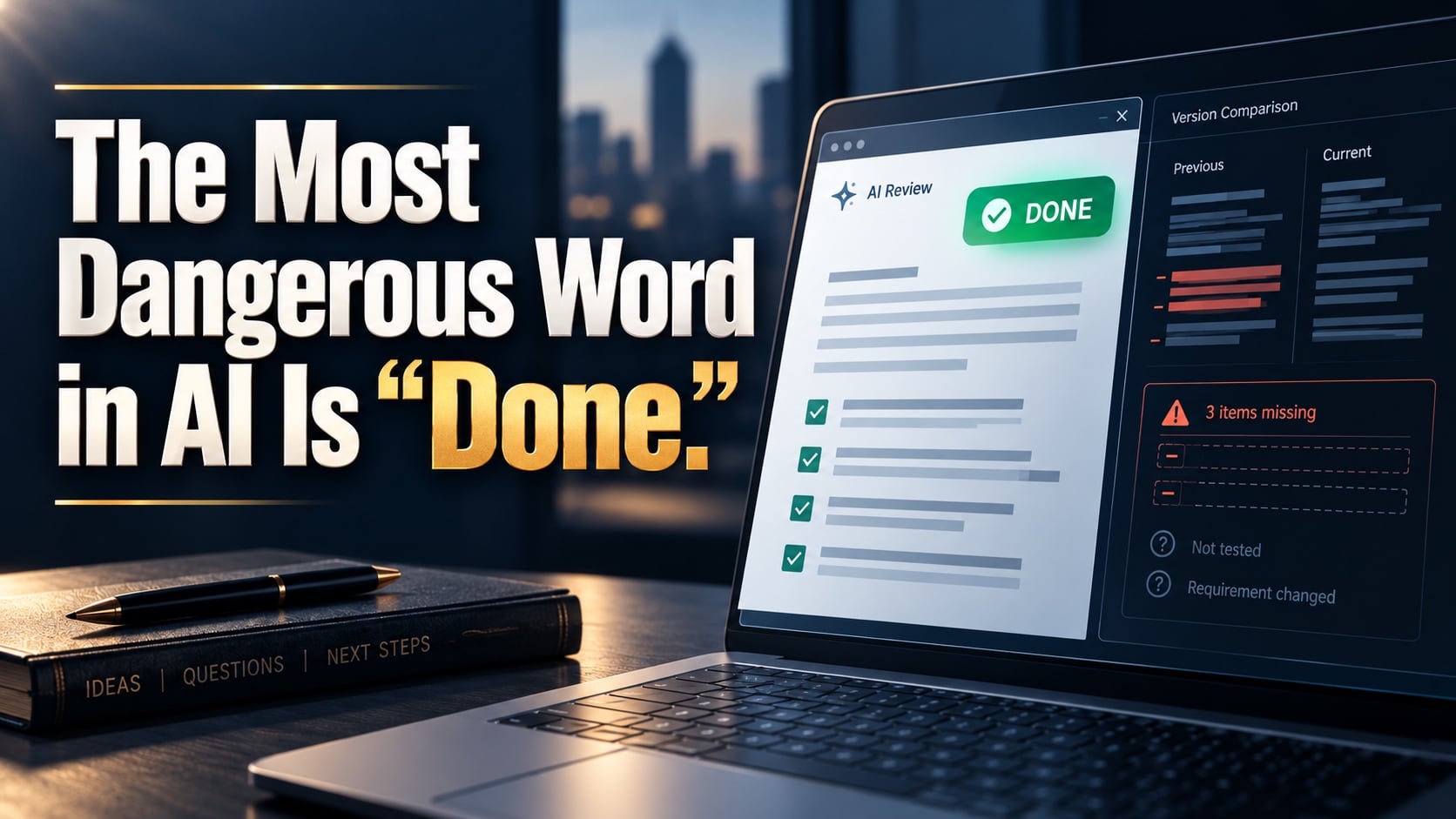
The Most Dangerous Word in AI Is “Done.”