






Chad’s Blog
Pragmatic Technologies for Life and Business Success®
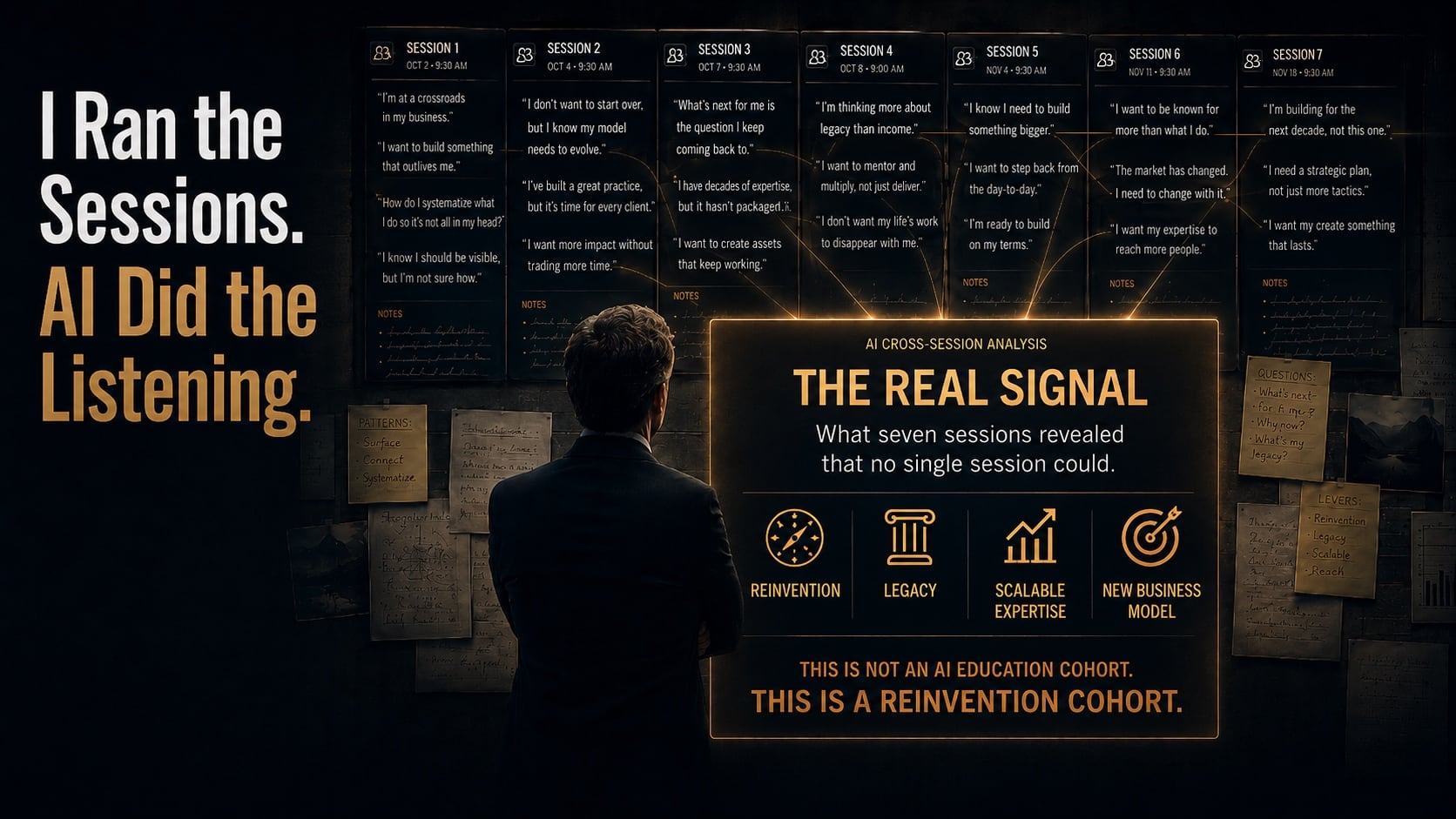
Seven sessions into the AI Insider Lab, I was confident I understood what was happening in the room. I had been present for every minute of every call. I use Glasp.co to transcribe each recorded Zoom session and run it through Claude’s analysis, which gives me a detailed read on what was covered, what questions surfaced, and where members are in their thinking. After every session, I review those notes carefully. I thought I had a clear and accurate picture of the group.
I was wrong. Not slightly wrong. Wrong in a way that would have quietly shaped every decision I made about the Lab going forward, and I never would have known it.
Here is what changed that.
After seven sessions, I decided to do something I had not done before. Rather than reviewing each session’s analysis individually, I organized all seven sessions inside a single Claude project, including each session’s member summaries, the private insights I had captured for my own use, and the insights worth sharing with the group. With that complete body of material in one place, I asked Claude to synthesize across all of it simultaneously, looking for patterns, themes, and signals that no single session could reveal. I gave it specific instructions: tell me what each member is actually working on beneath what they say they are working on. Tell me what the group is collectively communicating that no individual has articulated directly. Tell me what I am missing.
What came back stopped me.
You have been taking notes. You have not been listening.
Session by session, the Glasp analysis gave me accuracy. It captured what was said. It flagged the key questions and topics. What it could not do is read across seven conversations simultaneously and find the thread connecting all of them, because that thread does not live inside any single session. It lives in the aggregate. And the aggregate was telling me something I had completely missed.
I thought I was running an AI education group.
I was not. What AI revealed, reading across all seven sessions at once, is that the members of the founding cohort are not there primarily to learn about AI. They are there to answer a question that almost none of them had stated directly: what does the next chapter of my professional life look like, and how do I build it before it is too late to do it intentionally? Reinvention. Legacy. The business that outlives their direct involvement. Expertise accumulated over thirty or forty years that has never been converted into something scalable. The career built for one era that needs to be redesigned for what comes next.
That is not an AI education cohort. That is a reinvention cohort, and the only reason I know that is because AI revealed it. Not a member. Not a session note. Not my own observation after seven sessions in the room. AI, reading across everything simultaneously, saw what I could not see from inside it.
What I want to be clear about is that this did not happen by accident. The AI Insider Lab sessions are not focused on just prompting techniques or tool selection. They are built around a single discipline: how to leverage AI as a genuine thinking partner, one that challenges your assumptions, surfaces what you cannot see from inside your own expertise, and forces the kind of honest self-examination that most professionals spend entire careers avoiding. The workflows I designed were specifically built to take members deeper than a surface level AI conversation would ever go. And it is precisely because those workflows asked members to examine their expertise, their client relationships, and their business model at that depth that the reinvention question kept surfacing. The sessions created the conditions for that insight to emerge. AI, reading across all seven at once, was the first to name it. Even the technical capabilities I introduce, features that are reshaping what AI can do, only enter the room when they serve the work a member is already doing. Never as a standalone lesson. Always in service of the deeper work, using AI not as a feature to learn but as a thinking partner to think with.
And the diagnosis was not limited to what members needed. It extended to something more fundamental: a clearer understanding of what the group is actually building together. Nobody handed me this insight in a session. Nobody put it in a question or a comment. AI reading across all seven sessions simultaneously produced a read on the group that changed how I see the curriculum, how I sequence the work ahead, and what I understand the Lab to actually be doing for the people inside it. That level of clarity does not come from reviewing one session at a time. It comes from stepping outside the individual conversations entirely and letting AI show you what the whole body of them is saying.
That distinction matters more than any tool, any workflow, or any note-taking system you currently use. Because what your clients tell you in any single conversation is real, but it is partial. They surface the version of what they need that is most present for them that week, filtered through what they believe you can help with, shaped by what feels appropriate to raise in a professional context. The pattern underneath those conversations is the real signal. It is what they keep circling without naming. The need that appears every time, dressed differently each session. The strategic question driving everything else that they have never quite found the words for.
That pattern is sitting in your recorded conversations right now.
One member described compressing what would have been months of packaging work, turning decades of accumulated expertise into a structured offering, in a matter of days. That result was visible. The pattern underneath it was not: the same need surfaced across multiple members in different language across multiple sessions. The individual session notes told me what each person was building. The synthesis told me what they were all actually trying to solve.
The Discovery I Was Not Looking For
There was a second revelation inside the synthesis that I did not anticipate. Because I was working from exact transcripts rather than summaries, AI was also able to surface specific moments from across the sessions where members had said something genuinely powerful about their experience. Not paraphrases. Not approximations. The actual language they used, with the timestamps to find it.
I had been present for every one of those moments. I had moved past them in real time, focused on facilitating the session rather than registering the weight of what had just been said. The synthesis handed them back to me with the context to understand why they mattered. Member voices, in their own words, describing what the work was producing for them. Testimonials I had generated and then forgotten I had.
Your conversations contain the same material. The question is not whether it is there. It is whether you have ever asked AI to go find it.
What This Requires of You
It requires that you have the conversations recorded and transcribed. Most professionals do. It requires that you bring the body of those conversations to AI together, not one at a time, with a specific instruction to find what the individual sessions cannot show you. And it requires that you ask the right question: not what did my client say, but what is my client actually telling me across everything they have said.
The answer to that question is where your most valuable work begins. It is where you find the real problem underneath the presenting problem. The real outcome underneath the stated goal. The real fear underneath the logical objection. The pattern that defines what your client actually needs from you, and possibly the gap in how you have been serving them.
Your notes have been accurate. The question is whether accuracy is enough.
The AI Insider Lab founding cohort is well underway, and what members are producing, running reinvention work, extracting decades of expertise, and building tools they never imagined they could build, is the proof of what becomes possible when senior professionals use AI as a genuine thinking partner rather than a faster search engine. A new cohort opens September 4th. Next week I will share the full details, including what the Lab is, who it is built for, and how to reserve your spot before the group fills.
Stay tuned.