





Chad’s Blog
Pragmatic Technologies for Life and Business Success®
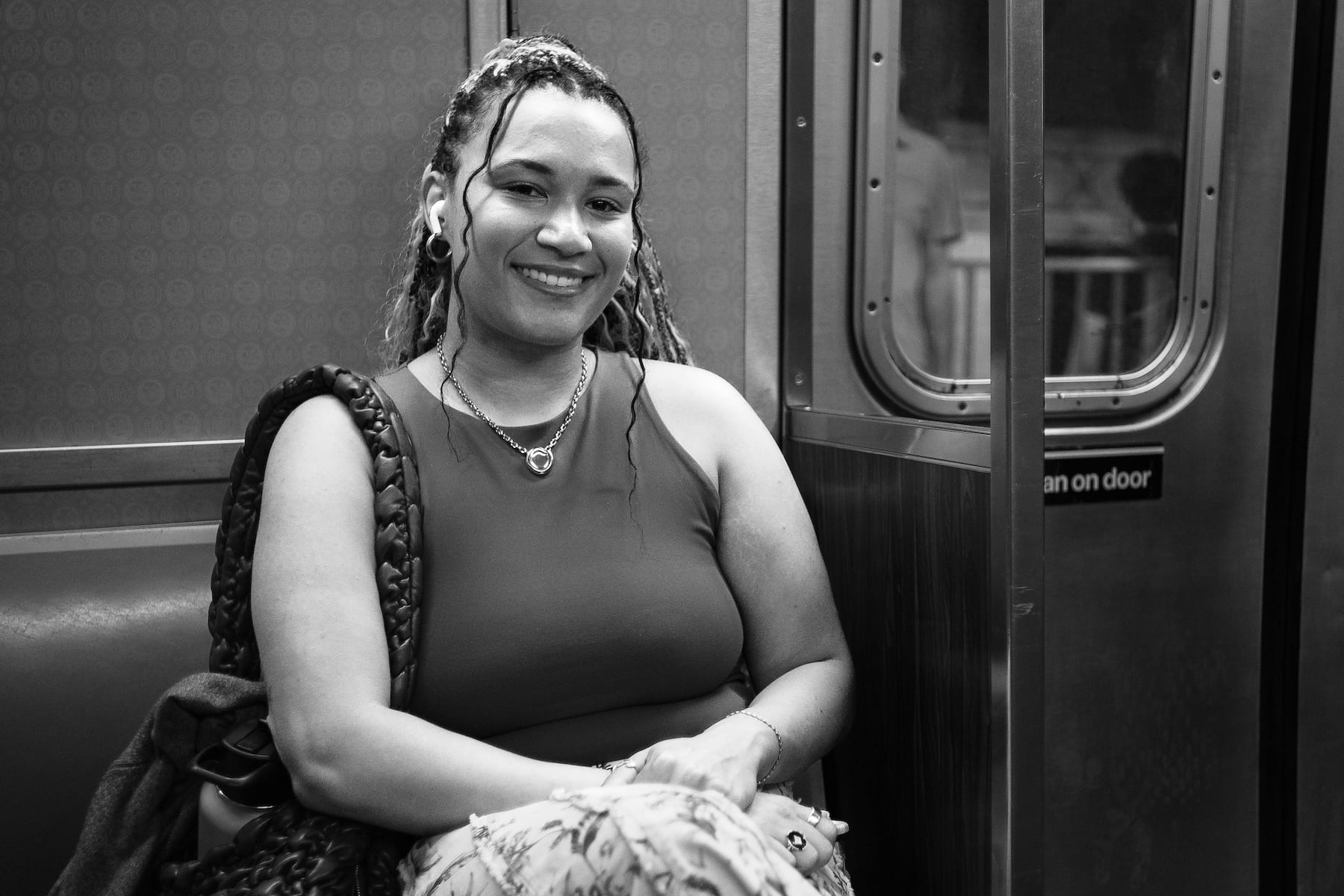
I am spending this week on the streets of New York, in a street photography workshop with Peter Turnley and a dozen other photographers. On the subway back from Coney Island, a young woman sat down across from me with her eyes closed, listening to music, somewhere far inside her own world. When she opened her eyes for a moment, I waved and told her I would be honored to capture a few photographs of her. She smiled and nodded. For the next few minutes I worked quietly, and those were some of the most genuine images I made.
Then I did the thing the camera cannot do. I sat down beside her and asked if I could show her some images from New York the year before. She loved them, and we started talking. Olivia is a singer and a Broadway actress. She had a role in Waitress, a production I happened to see with my wife a few years ago. “You probably saw me in it,” she said. We connected on Instagram and agreed to stay in touch.
Peter insists you do not take a photograph, you make one. On that subway I understood why. I made the photographs. The photographs were not what I captured.
This is the distinction I keep trying to make to my clients, and the street made it physical. A model can generate a flawless portrait of a woman on a subway with her eyes closed. It cannot wave at her, ask permission, honor the yes, show her last year’s New York on a phone screen, and discover a shared evening at the theater between two strangers. AI produces the deliverable. The human earns the relationship. The relationship, not the deliverable, is where the real value has always lived.
The Rule Was Never the Rule
Here is where it would be easy to hand you a rule. Always ask first. Lead with respect. Honor the person before the photograph. It is good advice, and most of the week it was exactly right. With Olivia, eyes closed and in her own world, asking was the only key that fit the lock.
Then there was Times Square. Late at night I walked into a loud street celebration, mostly young people dancing to rap blasting from a speaker, and I raised my camera and started capturing images without asking anyone. Within minutes I was pulled into the party, and I stayed for two hours. People shook my hand and traded high fives, and the young man running the celebration asked for my card so I would send him the photographs.
If the rule were always ask first, that night makes me a liar. Asking would have shattered the very thing I wanted to photograph. A public celebration already performing for the street did not need my permission slip. It needed me to step into its energy and let my presence ask the question my mouth did not.
So, the constant across both nights was not the asking. It was the read. The judgment about which approach the moment in front of me actually called for, and the courage to act on it. With Olivia, the answer was to ask with respect. In Times Square, the answer was to enter without a word. I chose correctly both times not because I followed a rule but because I read the humanity in front of me and responded to what was actually there.
The Market Is Selling You Rules. The Street Sold Me Judgment.
Your inbox and social media are full of rules for AI. Always prompt this way. Never trust the output. Here are the seven frameworks, the ten prompts, the one workflow that changes everything. Professionals are drowning in tactics. And tactics, like always ask first, work right up until the moment they are the wrong tool for what is in front of you.
The professional who only knows always ask permission freezes in Times Square. The professional who only knows always make AI argue against you fails the moment the work calls for producing a draft or an answer, not challenging it. The rule is not the skill. The skill is the calibrated read: knowing which approach the moment calls for, and having the courage to abandon it when it does not fit.
When I survey my clients, the dominant gap was is capability. Many of them already know what AI can do. What they need to build is the judgment about what it should do for them specifically, in their work, on their decisions. Calibration beats capability. In other words, reading the moment beats knowing the tools. The street handed me the most vivid proof of that I have ever held.
What I Actually Walked Away With
Notice how both nights ended. Olivia and I are connected on Instagram. The organizer in Times Square has my card and will contact me for his images. I did not extract a few images and disappear. Each exchange became a relationship with a future.
This is the whole argument against treating AI as a vending machine. The professional who walks up to AI, pulls an output, and leaves gets exactly that: an output, and nothing else. The professional who treats the exchange as the start of something, who brings judgment and curiosity and stays with it, builds something that compounds. The same is true of a stranger on a train. Extraction gives you a transaction. Engagement gives you a relationship that compounds.
AI will generate more images than humanity has ever produced. It will not earn a single relationship. That work is still ours, and it is the most valuable work we have.
This is the work we do inside the AI Insider Lab. Not which tool, not which prompt, but the judgment to know what AI should do for you specifically, and the discernment to read each situation for what it actually needs. It is a thinking environment for senior professionals rebuilding their practice around what endures. If that is the conversation you want to be in, I would welcome talking with you about it.

Get your copy of my latest new books available now on my Amazon’s author page.