






Chad’s Blog
Pragmatic Technologies for Life and Business Success®
Every week, I watch smart professionals use AI the same way. They open a new conversation, explain who they are, describe what they need, provide the context, ask their question, get an answer, close the window, and start the entire process over again next time. It is the equivalent of hiring a brilliant strategist and firing them at the end of every meeting.
This is how most people use AI. And it is exactly why most people get mediocre results from it.
The feature that changes this is called Projects in Claude. And it is, without exaggeration, one of the single highest leverage shift I have seen professionals make in how they work with AI. Not because of what it does technically, but because of what it forces you to do strategically: think clearly about what you actually need, define the context that matters, and design a system that compounds over time instead of resetting to zero with every session.
A project in Claude lets you set persistent instructions, context, and priorities that carry across every conversation inside it. You are no longer prompting from scratch. You are briefing an advisor who already knows your business, your goals, your blind spots, and exactly how you want to be challenged. The difference is not incremental. It is architectural. You move from asking one-off questions to operating inside a thinking system that gets sharper every time you use it.
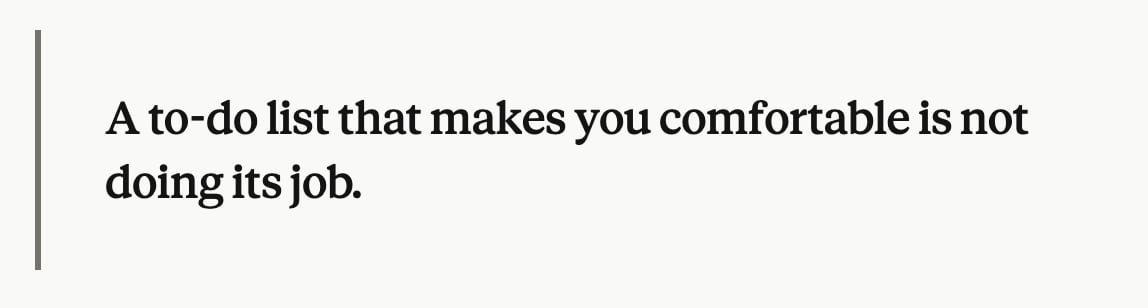
Let me show you what this looks like in practice. I built a project specifically to manage my weekly to-do list. But “manage” is the wrong word. The project does not just organize my tasks. It interrogates them first, then organizes what survives around what actually matters. Here is the condensed version of the instructions I created:
This has become a game changer for how I run my week. Every Monday, I paste in my raw to-do list and the system does its work. No re-explaining. No rebuilding context. Just a strategic audit from an advisor who already knows my priorities, my business, and where I tend to fool myself.
The specifics in my prompt are mine: my business, my priorities, my blind spots. The architecture is yours. If you are a consultant, swap in your practice context and client pipeline. If you are an advisor, load your engagement priorities and revenue targets. The structure transfers. The power comes from the precision of your context and the honesty of your instructions.
This is what separates people who “play with AI” from those who build with it. Projects are not a convenience feature. They are a strategic infrastructure decision. And once you experience the difference between briefing an advisor who knows you and explaining yourself to a stranger for the hundredth time, you will not go back.
If this kind of thinking resonates, it is exactly what we are doing inside the AI Insider Lab, my professional membership community for consultants, advisors, and thought leaders who want to work with AI at this level and beyond. Not lectures. Not courses. Live thinking, real problems, and an environment that evolves as the technology does. The founding group is underway. If you want to explore what the next group looks like, reach out and let’s have that conversation.